 Save
Save I remember the first time I saw a dish that truly moved with the eye—it was at a small gallery restaurant where the chef arranged vegetables with such deliberate chaos that my gaze couldn't help but follow a path from vibrant density to delicate dispersal. I was captivated by how something so visual could taste just as intentional. That night sparked an obsession with creating my own version, one where the plate becomes a landscape of motion frozen in time, and every element—from the golden beets to the whisper of microgreens—tells a story of artful restraint.
I made this for a dinner party where one friend had just returned from a design residency in Copenhagen, talking endlessly about minimalist plating. I wanted to show her something that was minimal in ingredients but maximum in visual intention. When I set down the platter with its gradient of motion, the whole table went quiet—that particular silence where you know you've created something memorable.
Ingredients
- 1 small golden beet, thinly sliced: The warm, honeyed sweetness creates the emotional anchor of the dish. Slice it paper-thin on a mandoline so the light passes through the translucent edges—that's where the real beauty lives.
- 1 small red beet, thinly sliced: Deep magenta depth that holds visual weight in the dense cluster. The earthiness here needs to be in balance with the sharpness coming from other elements.
- 1 small watermelon radish, thinly sliced: This is your visual surprise—that shock of hot pink and white stripes catches the light and makes people lean in closer. It's worth seeking out at farmers markets.
- 1 Persian cucumber, thinly sliced: Fresh, cool, and slightly sweet. Slice these last so they don't weep onto your cutting board, and pat them dry before plating or they'll make everything soggy.
- 4 baby carrots, peeled and sliced on a bias: The bias cut elongates them, which somehow makes them feel more intentional, more part of the design. Taste one raw to make sure they're actually sweet—that matters here.
- 80 g creamy goat cheese, at room temperature: Let it sit on the counter for 20 minutes. Cold goat cheese is impossible to dot delicately, but room-temperature cheese settles into little clouds of richness. This is the protein moment, subtle but essential.
- 2 tbsp toasted hazelnuts, roughly chopped: Buy them already toasted if you can find them, or toast them yourself in a dry pan for 5 minutes—you'll know they're done when your kitchen smells like a European autumn. The crunch here is crucial.
- 1 tbsp black sesame seeds: These almost disappear visually until the light hits them just right, which is the whole point. They add a mineral quality and toasted depth that wouldn't exist without them.
- 1/2 cup microgreens (such as arugula or radish): These are your feathering tool. Buy them the morning of or the day before—they bruise easily and should feel crisp, not slick. Arugula microgreens give peppery intensity; radish microgreens are even more alive.
- 1 tbsp fresh dill, fronds only: Soft, anise-tinged, and visually tender. Pick this fresh and use it immediately. Dill that's been sitting in the fridge tastes like grass clippings, but fresh dill tastes like a garden after rain.
- 2 tbsp extra virgin olive oil: The foundation of the dressing and the glossy finish. Use something you actually love tasting, not just something labeled expensive. The quality here is non-negotiable.
- 1 tbsp fresh lemon juice: Squeeze it yourself. Bottled lemon juice tastes like disappointment. This single tablespoon is what makes every element taste like itself, brighter and more true.
- 1 tsp honey: Just enough to round out the brightness and acknowledge the vegetable's natural sweetness. It's a whisper, not a shout.
- Salt & freshly ground black pepper, to taste: Taste as you go. Vegetables vary wildly in sweetness and need different amounts of seasoning depending on where they came from and the season.
Tired of Takeout? 🥡
Get 10 meals you can make faster than delivery arrives. Seriously.
One email. No spam. Unsubscribe anytime.
Instructions
- Make your dressing first:
- Whisk the olive oil, lemon juice, honey, salt, and pepper together in a bowl. Taste it. It should make your mouth water and feel slightly sharp. This is your flavor foundation, so spend 30 seconds here making sure it sings.
- Arrange the vegetables with intention:
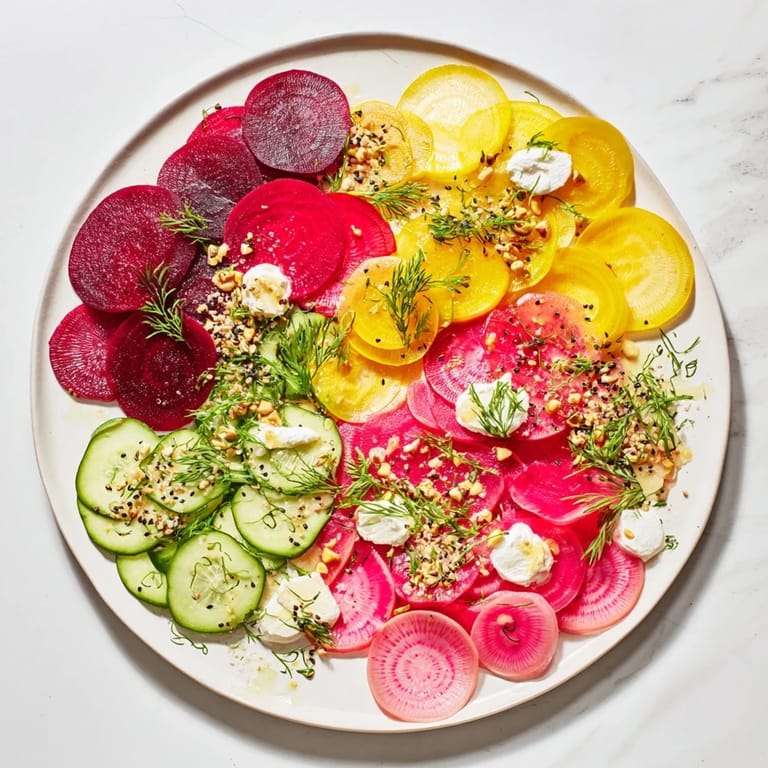
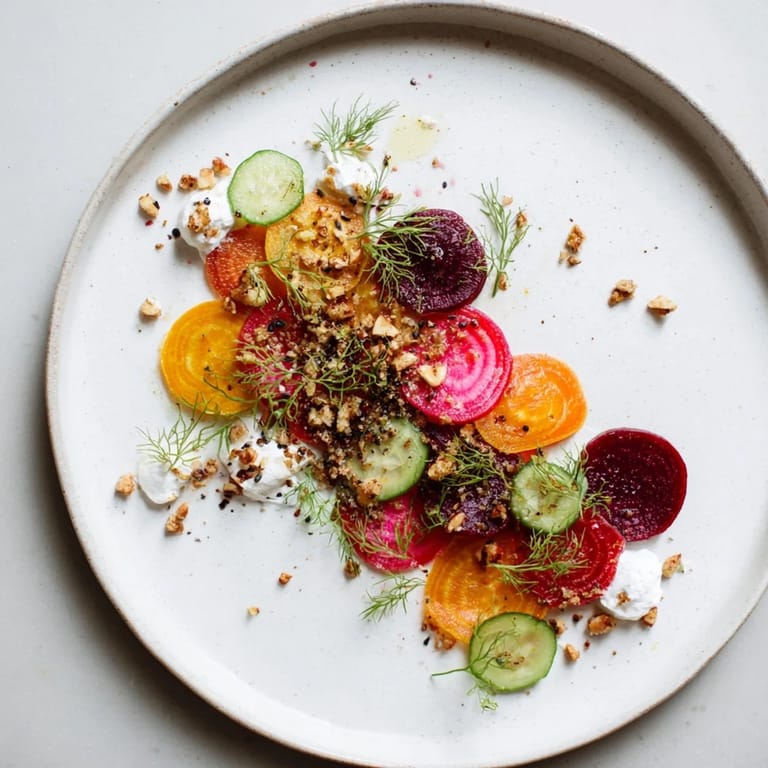
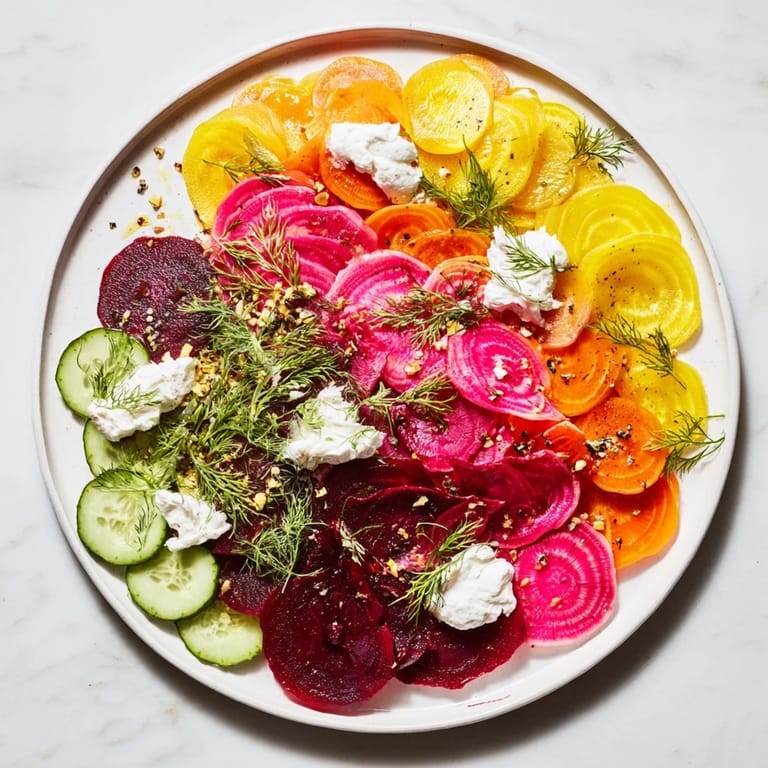
- Start on one side of your platter or plate—let's call this the dense side. Overlap your sliced vegetables closely here, letting them lean against each other like they're in conversation. Think about color: cluster the reds together, let the golden beets catch the light, scatter the watermelon radish where it will surprise. As you move toward the opposite edge, gradually spread the slices out, leaving more negative space. This is the blur effect—your eye should naturally travel from chaos to calm, following the density gradient.
- Scatter the goat cheese like clouds:
- While the cheese is still soft and spreadable, place small dollops—about the size of a teaspoon—among the densest vegetables. Then place progressively fewer dollops as you move toward the sparse side. The cheese should feel random, but it should clearly be more present where the vegetables crowd together.
- Toast and scatter the hazelnuts:
- Distribute the chopped hazelnuts with the same density principle: more on the clustered side, trailing off to almost nothing at the edges. The visual weight and crunch should follow the same path as everything else.
- Sprinkle the sesame seeds with precision:
- These tiny seeds catch light and add sophistication. Use the same density-to-sparse distribution. They're small enough that their placement can feel organic and natural.
- Add your greens last:
- The microgreens and dill should be the final layer, positioned to enhance the blur effect. More concentrated where the vegetables are dense, barely present at the edges. These delicate leaves should feel like they're just landing on the plate.
- Dress and serve immediately:
- Drizzle the dressing across the entire platter, but use less on the sparse side to preserve the visual effect. The dressing should gloss everything slightly without pooling. Serve right away while the vegetables are crisp and the visual impact is sharp.
 Pin it
 There's a moment that happens after you've placed the last microgreen and stepped back to look at what you've created—a moment where you realize you've made something that exists in the space between art and food, and it matters. That's when someone walks into the kitchen and catches their breath, and you know you've succeeded in making them see vegetables differently.
Building Your Kinetic Landscape
The genius of this dish is that it teaches you something fundamental about plating and presentation: constraint creates meaning. Every element isn't just placed randomly—it's placed in relationship to the density gradient. The vegetables aren't fighting for space; they're telling a story of movement through stillness. Once you understand this principle with vegetables, you'll see it everywhere: in fashion, in painting, in the way people naturally arrange themselves in a room. Start with this dish, and you'll never plate anything quite the same way again.
Choosing Your Vegetables Seasonally
Winter root vegetables are forgiving and beautiful, but spring and summer open up entirely different possibilities. In summer, try thin-sliced radishes in every color, paper-thin zucchini, and delicate cucumber ribbons. In fall, experiment with thinly shaved fennel, golden and candy-striped beets, and purple carrots. The principle stays the same—you're looking for vegetables that slice thin, hold their color, taste bright, and photograph beautifully. Visit a farmers market and buy whatever makes you stop and stare. That staring moment is exactly the feeling you want someone to have when they see your finished plate.
The Art of Vegetable Arrangement
This technique is modular. Once you understand the blur principle, you can apply it to any ingredients you have on hand. Add thin slices of smoked salmon or trout for richness. Make it vegan by substituting creamy cashew cheese or a cashew cream dollop for the goat cheese. Scatter edible flowers if they're in season—pansies, nasturtiums, and violas add a whimsical touch that feels natural among the greens. Top with a drizzle of aged balsamic for depth, or a sprinkle of pomegranate seeds for a jewel-like quality. The density gradient works with whatever you choose.
- Always slice vegetables within 30 minutes of serving to preserve crispness and prevent oxidation.
- The cheese should be soft enough to spread but cold enough to hold its shape—room temperature is the perfect balance.
- If you're worried about balance, remember that visual weight and actual weight don't have to match. One colorful radish can anchor a whole sparse section.
 Pin it
 This dish proves that with just vegetables, careful attention, and a clear creative vision, you can create something that feels as much like art as it is like food—the kind of thing that makes people want to come back to your table just to see what you'll create next.
Frequently Asked Questions
- → How is the motion blur effect achieved in the dish?
By densely overlapping sliced vegetables on one side and gradually spacing them out towards the other, creating a transition from clustered to sparse elements.
- → What types of vegetables work best for this composition?
Thinly sliced root vegetables like golden beet, red beet, watermelon radish, along with Persian cucumber and baby carrots, provide vibrant colors and texture contrasts.
- → Can I substitute the goat cheese with a vegan alternative?
Yes, plant-based cheese can replace goat cheese to maintain creaminess without dairy.
- → What role do the toasted hazelnuts and seeds play?
They add crunch and a nutty depth that contrasts with the creamy cheese and fresh vegetables.
- → How should the dressing be applied for best effect?
Drizzle the honey-lemon olive oil dressing lightly across the platter, using less on the sparse side to enhance the fading motion look.
- → Are there suggested wine pairings for this dish?
Crisp Sauvignon Blanc or a dry sparkling wine complements the fresh, vegetal flavors.