 Save
Save I first encountered The Golden Ratio Shell at a small patisserie in Brussels, where the pastry chef explained how mathematics and beauty converge in dessert. Watching her hands arrange those perfect spirals, each curve narrower than the last, felt like witnessing edible geometry come to life. That day, I realized that the most memorable desserts aren't just delicious—they tell a story through their structure. This dessert became my obsession, and after months of practice, I've finally cracked the secret to creating layers that look like they were designed by nature itself.
I'll never forget plating this dessert for my sister's engagement dinner. As guests arrived, their eyes went straight to the table, and before anyone took a bite, they were already pulling out their phones. That's when I knew I'd created something special—a dessert that earned its place on the plate through pure visual grace, and then backed it up with flavors that made everyone close their eyes on the first bite.
Ingredients
- All-purpose flour: Use a light hand when folding this into your eggs. Over-mixing develops gluten and deflates your sponge, turning it dense instead of cloud-like. The flour is just there to give structure, nothing more.
- Granulated sugar: This isn't just sweetness. When you whisk it with eggs, you're incorporating thousands of tiny air bubbles that make your sponge rise and your mousse airy. Don't skip the whisking time.
- Large eggs: Room temperature eggs whisk to greater volume than cold ones. Take them out 30 minutes before you start. Trust me on this small detail.
- Unsalted butter, melted: The butter must be warm but not hot when you fold it in, or you'll cook the eggs. Use a gentle hand—this is where most home bakers lose their sponge's texture.
- Vanilla extract: Pure vanilla, always. The artificial stuff tastes tinny against the dark chocolate and delicate fruit layers.
- Fresh raspberry puree: This is where the soul of your jelly lives. If you must use frozen raspberries, defrost them gently and pass through a fine sieve. The fresher the flavor, the more the spiral stands out.
- Powdered gelatin: Bloom it properly in cold water for 5 minutes, then dissolve it gently. This single step separates a wobbly, broken jelly from one that slices clean and holds its spiral shape beautifully.
- Dark chocolate, 70%: High quality chocolate makes all the difference in mousse. The cocoa butter in good chocolate creates that melt-on-your-tongue luxury. Cheaper chocolate seizes and splits.
- Heavy cream: For whipping, use cream that's been chilled along with your bowl and beaters. Cold cream whips faster and holds peaks longer, giving you that stable, airy texture.
- Egg yolks: These emulsify the mousse and create that glossy shine. Don't let them scramble when tempering—add cream slowly and whisk constantly.
- White chocolate: This is your glaze and final elegance. Choose one with real cocoa butter, not palm oil. The difference in how it sets and how it looks is remarkable.
- Edible gold leaf: This is pure theater, but theater matters in plating. It catches light and whispers luxury without demanding attention.
Tired of Takeout? 🥡
Get 10 meals you can make faster than delivery arrives. Seriously.
One email. No spam. Unsubscribe anytime.
Instructions
- Prepare your workspace:
- Line your baking tray with parchment paper and set your oven to 180°C. Having everything ready before you start is non-negotiable in dessert making. The moment you whisk those eggs, you're working against gravity and time.
- Create the sponge base:
- Crack your eggs into a mixer bowl and add sugar. Whisk for a full 5 minutes until the mixture is pale, thick, and leaves ribbons when you lift the whisk. This ribbon stage is crucial—you're building the foundation of air that keeps your sponge tender. Sift flour and salt over this, then fold gently with a spatula, rotating the bowl as you work. The moment the flour disappears, stop. Fold in your warm butter and vanilla in two additions, keeping strokes light and confident. Spread into your prepared tray and bake for 10–12 minutes until golden and springy to the touch. Cool completely before cutting into 8 rectangles, each sized to honor those 5 by 8 centimeter proportions.
- Build the jelly spiral:
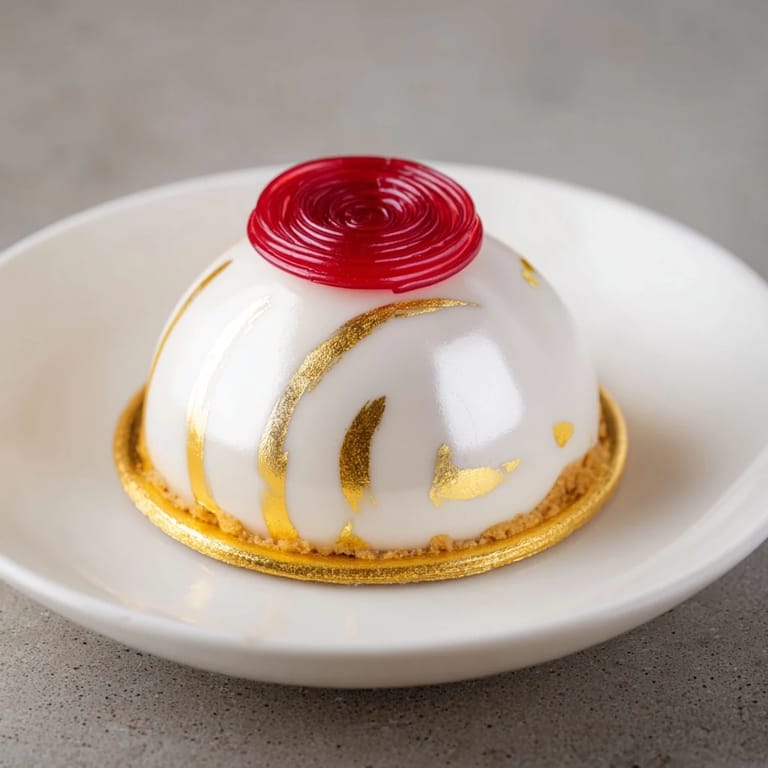
- Sprinkle gelatin over cold water and let it sit untouched for 5 minutes. This blooming step hydrates the gelatin so it dissolves smoothly without lumps. Heat your raspberry puree and sugar together until steaming but not boiling. Remove from heat, add the bloomed gelatin, and stir until it melts completely. A few drops of lemon juice brighten the flavor and help the set. Pour into your lined tray and chill for at least 2 hours until completely firm. Now comes the art—cut your jelly into spirals, starting with a 3-centimeter-wide strip that gradually narrows to 1.8 centimeters as you curve it. Each spiral mimics nature's Golden Ratio, and watching it come together feels like you're sculpting in glass.
- Whip the chocolate mousse:
- Chop your dark chocolate fine and set it over a bain-marie—a bowl nested over simmering water. Never let the bowl touch the water or get too hot. Once melted and smooth, set aside. In a separate bowl, whisk your egg yolks and sugar until pale and ribbon-like, about 3 minutes. Heat your cream until wisps of steam rise, then very slowly drizzle it into the yolks while whisking constantly. This tempering prevents scrambled eggs. Pour the tempered yolk mixture into your melted chocolate and whisk until glossy and combined. Add vanilla. Cool this to room temperature. Whip your remaining cream to soft peaks—it should hold its shape but still look pillowy, not stiff. Fold this whipped cream into the chocolate in two additions, using broad strokes to keep the air bubbles intact. Your mousse should be airy, rich, and ready to pipe.
- Assemble each dessert:
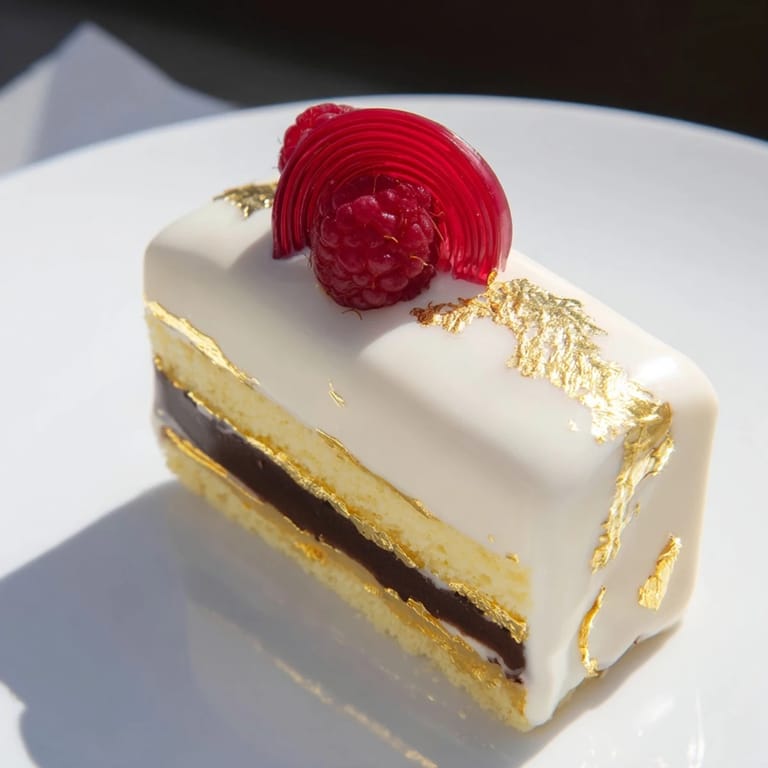
- Place a sponge rectangle on your serving plate or plating surface. Using a piping bag, create a layer of mousse about 3 centimeters high, spreading it to the edges of the sponge. Now lay your jelly spiral on top, starting from the center and curving outward in that perfect Fibonacci sequence. Each twist should catch the light and make people pause before they eat. If you're making multiple servings, take a moment between each one to admire what you're creating. This is where the dessert becomes meditation.
- Crown with the glaze:
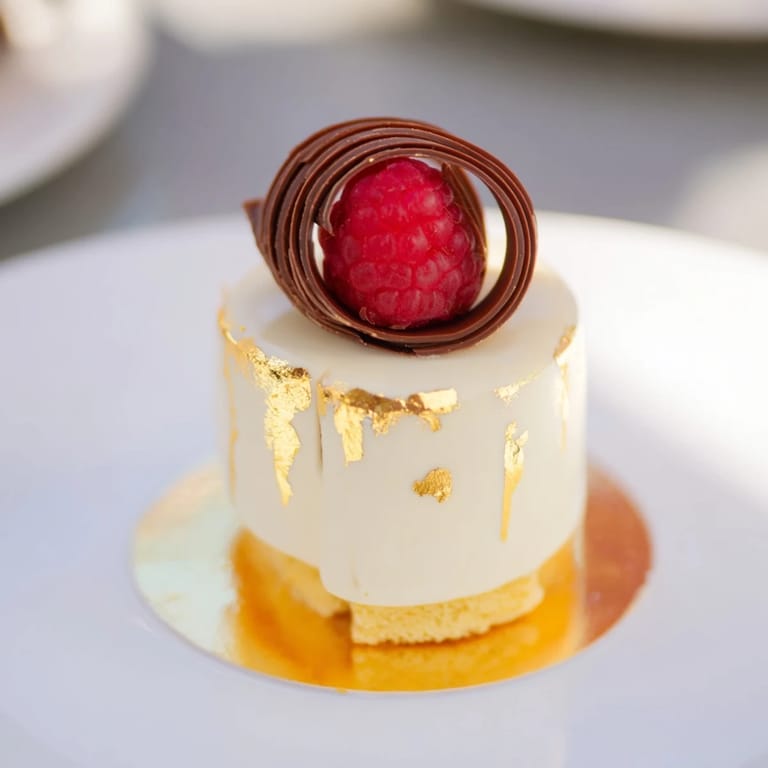
- Chop your white chocolate and place it in a small bowl. Heat cream until steaming and pour it over the chocolate. Let sit for one minute, then stir until silky and smooth. Cool slightly until it reaches the consistency of heavy cream. Pour this glaze over each assembled dessert in a single, confident motion. It should flow like silk, coating everything in glossy elegance. If using gold leaf, place it now, while the glaze is still slightly warm. Let it settle into the surface like a whisper of opulence.
- Chill and serve:
- Refrigerate your finished desserts for at least 2 hours. This isn't just about setting the glaze—it's about the mousse reaching that perfect texture where it's creamy but holds its shape. Serve chilled, perhaps with a small glass of Moscato d'Asti or Champagne. The bubbles against the chocolate, the sweetness against the bright jelly—it's a moment worth savoring.
 Pin it
 I served this dessert at a gathering where a mathematician was a guest. She spent ten minutes studying the spiral with a magnifying glass she happened to have, pointing out proportions I hadn't consciously calculated. That's when I realized this dessert is a conversation between your hands and something larger than taste—it's about creating harmony that people recognize even if they can't name it.
Why the Golden Ratio Matters Here
The Golden Ratio appears everywhere in nature—in flower petals, in seashells, in the proportions of your own face. When you recreate it in dessert, you're not just showing off mathematical knowledge. You're creating something that feels right to the human eye before the human mouth even tastes it. This dessert teaches your guests that beauty and mathematics aren't opposites. They're dancing partners, and this plate proves it.
Mastering the Spiral Cut
Cutting your jelly into the perfect spiral will take practice, and that's okay. The first time, you might end up with messy strips. The second time, you'll get closer. By the third or fourth attempt, your hands will understand the curve. Use a sharp knife warmed under hot water and wiped dry between cuts. The heat softens the jelly slightly, making the blade glide instead of drag. If your spiral breaks, use the pieces anyway—they still taste exactly right, and imperfection is more honest than perfection.
When Everything Comes Together
The magic moment happens when you plate the final dessert and step back. That's when you see what you've built—layers of mathematics and memory, texture and technique, all in service of a single perfect bite. And when you finally eat it, every element—the tender sponge, the silky mousse, the jewel-bright jelly, the luxurious glaze—has earned its place.
- Practice your spiral cut on a plain gelatin batch before you commit to the raspberry version.
- If your mousse separates or looks grainy, it overheated. Start fresh, and remember that chocolate is forgiving if you work slowly.
- Serve this with wine, with conversation, with people who appreciate that you've spent time creating something beautiful just for them.
 Pin it
 Every time I make this dessert, I'm reminded that cooking is about more than flavors and textures—it's about patience, precision, and the decision to make something beautiful. Serve this cold, serve this with intention, and watch your guests discover what you already know: that the most memorable meals aren't just eaten, they're experienced.
Frequently Asked Questions
- → How is the golden ratio applied in this dessert?
The dessert’s layers and jelly spiral are sized and arranged according to the Golden Ratio, creating visually balanced and harmonious proportions.
- → Can other fruits be used instead of raspberry puree?
Yes, mango or passionfruit purées are excellent alternatives that maintain the vibrant color and tangy flavor.
- → What is the purpose of the gelatin in the jelly layer?
Gelatin helps the fruit puree set firmly into spiral strips, allowing it to hold its shape and texture within the layered dessert.
- → How should the mousse be prepared for the best texture?
The chocolate mousse is made by gently melting dark chocolate and folding it with softly whipped cream and tempered egg yolks for a rich, airy consistency.
- → What is the ideal chilling time for this dessert?
Chilling assembled layers for at least 2 hours allows them to set fully and the flavors to meld beautifully before serving.
- → Is there a recommended drink pairing?
A crisp Moscato d’Asti or Champagne complements the dessert’s sweetness and texture perfectly.